
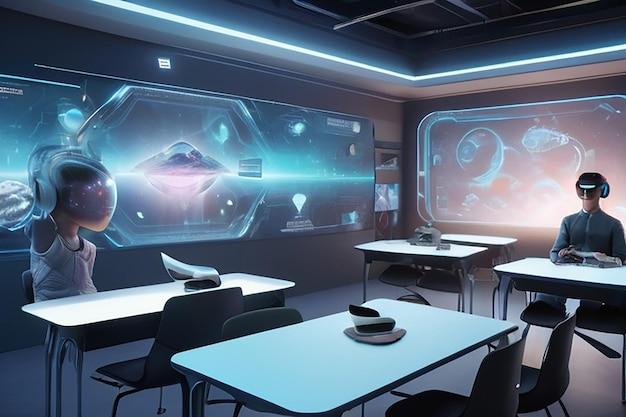
the Future of Augmented Reality in textbooks: Revolutionizing Learning with Interactive technology
Introduction
Imagine opening a textbook and watching history come alive or seeing complex mathematical models projected in 3D right in front of your eyes. This vision is rapidly becoming reality as augmented reality (AR) transforms customary textbooks into immersive and interactive learning experiences. As technology continues to advance, the integration of augmented reality in textbooks is poised to revolutionize education, making learning more engaging, memorable, and effective for students of all ages.
What is Augmented Reality in Textbooks?
Augmented reality overlays digital content—such as 3D models, animations, audio narrations, and videos—onto the real world using a smartphone, tablet, or AR glasses. In the context of textbooks, AR adds interactive elements to static pages. By scanning specific images or QR codes within a textbook, students can unlock supplementary educational materials that enhance understanding and engagement.
Benefits of Augmented Reality in Textbooks
- Enhanced Engagement: Interactive AR content makes learning fun, captivating students’ attention and encouraging curiosity.
- Improved Retention: Visually rich experiences help students remember details longer by appealing to multiple senses.
- Personalized learning: AR allows learners to interact at thier own pace, revisiting content as needed for better comprehension.
- Accessible Learning: Features like audio narration, translations, and interactive quizzes can accommodate diverse learning needs.
- Real-World Connections: AR bridges the gap between theory and practice, making abstract concepts tangible and relevant.
- Environmentally Kind: AR technology can reduce paper usage by delivering updated content digitally.
The Future of Augmented Reality in Textbooks
As educational technology evolves, AR in textbooks is expected to become more sophisticated and accessible. Here are some notable trends shaping this future:
- Increased Adoption: Schools, colleges, and universities worldwide are integrating AR textbooks to modernize curriculums and foster 21st-century skills.
- Cross-Platform Compatibility: AR content will become available across a wider range of devices, from smartphones to dedicated AR glasses, ensuring greater reach.
- AI-Powered Personalization: Artificial intelligence will enable adaptive learning paths, providing customized AR experiences based on each student’s progress and learning style.
- Collaborative Learning: Shared AR experiences will encourage teamwork, allowing groups of students to solve problems and complete tasks together in augmented spaces.
- Content Expansion: As publishers and educators produce more AR-ready textbooks,subjects such as science,history,geography,and arts will become deeply interactive.
Case Studies: Augmented reality Textbooks in Action
1. Pearson’s Interactive Science
One of the pioneers, Pearson, has developed AR-enabled science textbooks where students can explore 3D cell structures, participate in virtual experiments, and visualize processes like photosynthesis. Research shows students using these tools demonstrate a higher understanding and engagement compared to traditional materials.
2. Wonderscope by Within
Wonderscope turns classic storytelling into an interactive adventure, allowing children to step into the story and participate in the narrative. This approach has shown improvements in literacy and comprehension skills for early learners.
3.EON Reality’s Chemistry Books
EON Reality provides AR chemistry textbooks that let students manipulate 3D molecules, observe chemical reactions, and conduct safe virtual experiments. Teachers appreciate how these tools demystify complex scientific concepts.
Firsthand Experiences: Voices from the Classroom
“For the first time, I saw my students genuinely excited about a history lesson. They watched a 3D reconstruction of ancient Rome rise from the textbook, and it sparked classroom discussions like never before.”
— ms. Katherine L., Middle School Teacher
“As a visual learner, AR textbooks helped me finally understand geometry.Rotating 3D shapes made everything click.”
— Daniel P., High School Student
Practical Tips for Implementing AR Textbooks in the Classroom
- Start Simple: Introduce a pilot lesson using AR features, such as enhancing a single chapter with interactive content.
- Ensure Accessibility: Make sure all students have access to AR-enabled devices. Consider loaner programs or using school devices.
- Teacher Training: Organize workshops to familiarize teachers with AR tools and provide ongoing support.
- Integrate with Curriculum: Align AR features with learning objectives to enhance—not replace—core instructional content.
- gather Feedback: Regularly collect input from students and educators to refine and improve AR experiences.
Potential challenges and Solutions
- Cost Barriers: Initial investment in AR-equipped textbooks and compatible devices can be high.Solution: Seek grants,partnerships with tech companies,and phased rollouts.
- Digital Literacy Gaps: Not all students or teachers are familiar with AR technology.Solution: Provide training and easy-to-follow guides.
- Content Quality: The effectiveness of AR relies on well-designed, curriculum-aligned content. Solution: Collaborate with educational publishers and instructional designers.
Frequently Asked Questions about Augmented Reality in textbooks
How does AR enhance textbook learning?
AR enriches textbooks by adding interactive 3D models,videos,and quizzes,making complex subjects easier to understand and more engaging.
Is augmented reality in textbooks suitable for all ages?
Yes, AR textbooks are customizable and can be tailored for primary, secondary, and higher education, adapting content complexity accordingly.
What equipment is needed for AR textbooks?
Typically, a smartphone or tablet with a camera and AR app is sufficient.advanced classrooms may use AR glasses for hands-free experiences.
Are AR textbooks replacing traditional textbooks?
Not entirely. Augmented textbooks are designed to complement and enhance traditional learning, making existing materials more interactive.
Conclusion
The future of augmented reality in textbooks is not just a trend—it’s a transformational leap for education. By seamlessly blending interactive technology with trusted learning materials, educators can unlock new creative possibilities and empower students to become motivated, lifelong learners. Whether you’re a teacher, publisher, or education technology enthusiast, now is the perfect time to explore this innovative approach and prepare for the dynamic classrooms of tomorrow.
Ready to embrace the future of interactive education? Start your augmented reality journey today and witness the evolution of learning firsthand.